
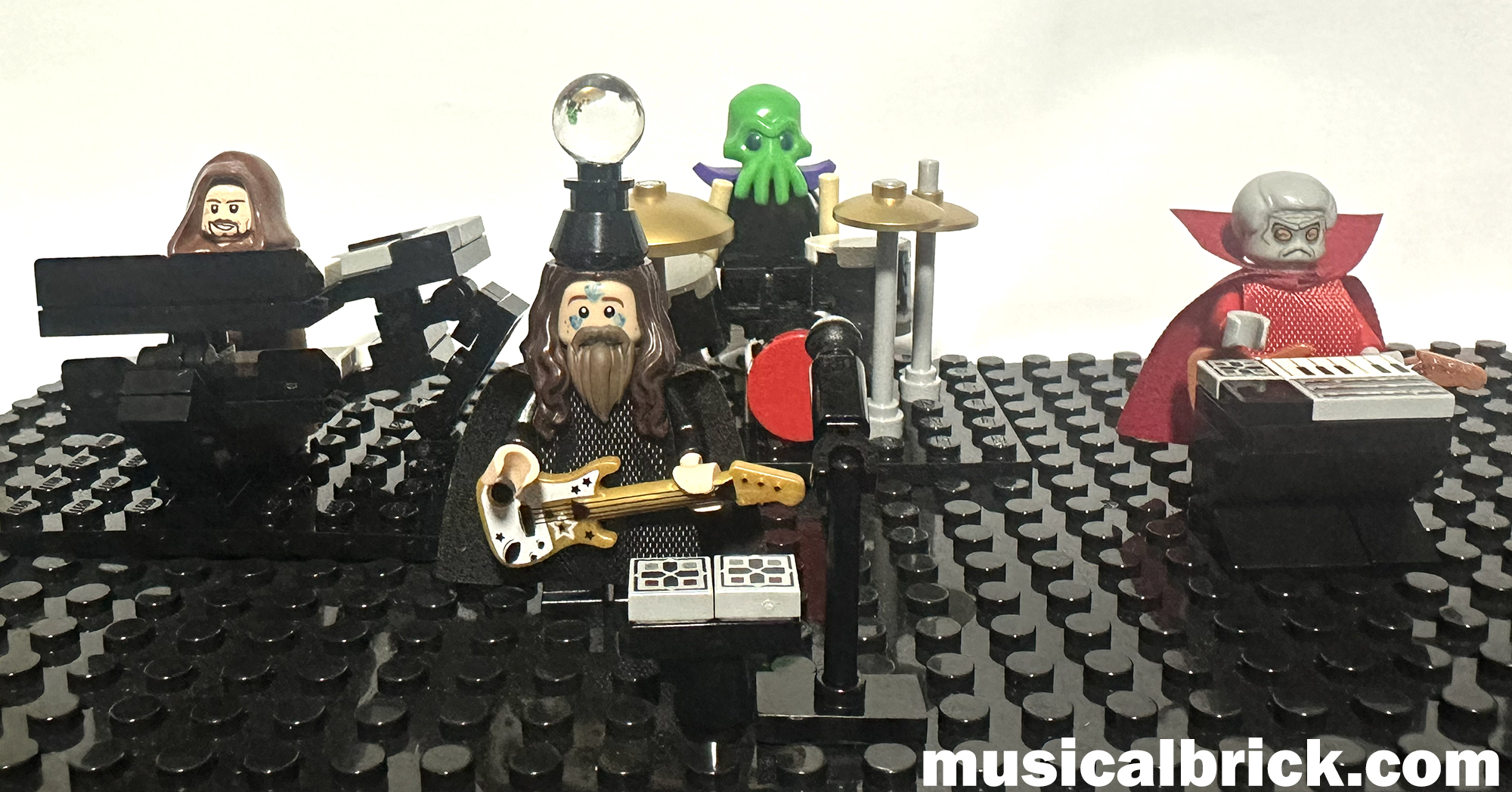
The actual Stone Henge is made from blocks. Blocks are sometimes bricks. Maybe this was inevitable.
Every Musical Brick build starts the same way. I look at something. I ask whether the pieces exist. I start making compromises.
Henge were going to be a problem.
If you have not encountered Henge yet, the short version is this: four musicians from Manchester who perform as alien characters called Zpor, Goo, Sol and Nom, play a genre they invented called Cosmic Dross, and open every show by greeting the audience as “Hello humans.” They formed in 2015. They were a cult act. Then CNN covered them in March 2026 and the word got out. They are simultaneously one of the funniest and most musically serious bands in the UK right now. I wrote about them properly [here].
Four minifigures. Three alien characters and one human. Each one distinct enough that a Henge fan would recognise them immediately.
This is, on paper, the same brief as any other Musical Brick project. In practice it is completely different.
Zpor: the Plasma Ball Problem
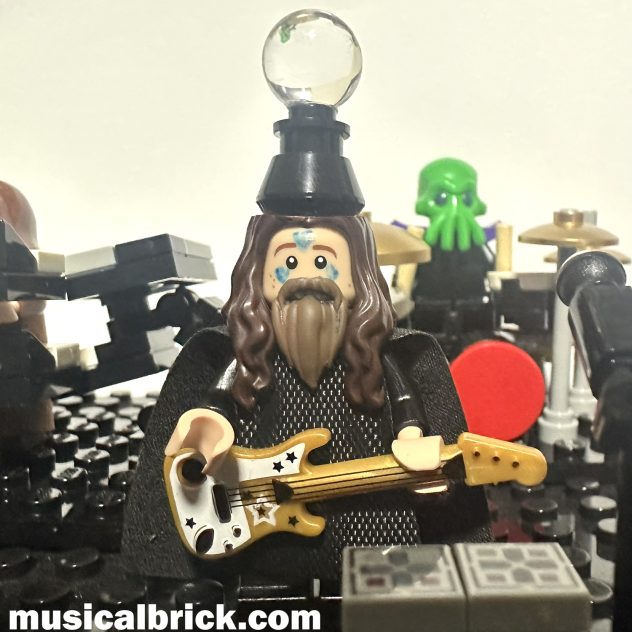
Zpor is the frontman. Vocalist, guitarist, cosmic messenger from the destroyed planet Agricular. His real name is Matthew Whitaker. His defining visual feature is a headdress with a plasma ball sitting on top, surrounded by beaded details and elaborate robes. You can see it clearly in live photographs. The orb is not tucked away. It catches the light. It is the thing your eye goes to first.
A plasma ball in LEGO. There is no such piece. So I made one.
A 1cm clear acrylic ball, glued to a LEGO 1×1 round plate. The hat itself is a cone piece. It is not a standard LEGO element. It is a solution. And in this case the solution is the point: some problems cannot be solved by reaching into the parts bin. They require a decision that only a builder can make.
Goo: the Venusian Bassist
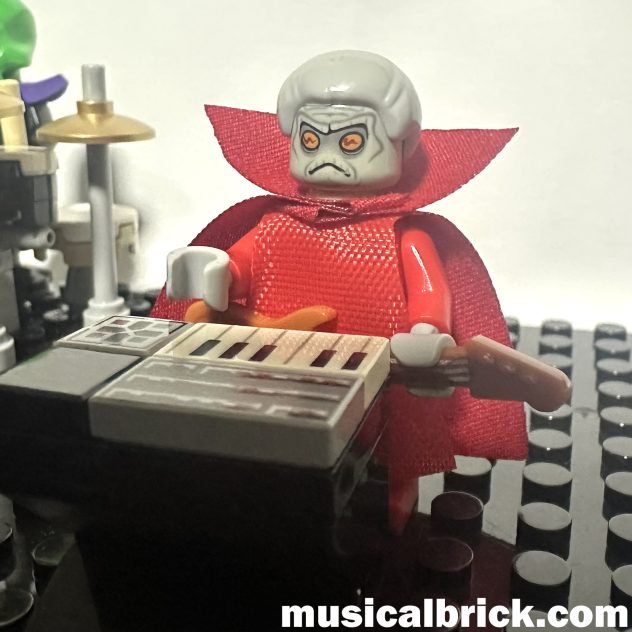
Goo is the sole survivor of a climate catastrophe on Venus. He plays bass and synth bass, and his look is where Star Wars unexpectedly becomes useful. Pete Turner plays him.
The head is Nute Gunray. The Trade Federation Viceroy from the prequel films. Long face, alien authority, something between regal and unsettling. It works for Goo in a way that is hard to explain until you see it. Then it is obvious. Red capes complete the look, adding the kind of cosmic gravitas that says: this being has survived the destruction of an entire planet and dressed accordingly.
Nom: the Drummer from Sirius
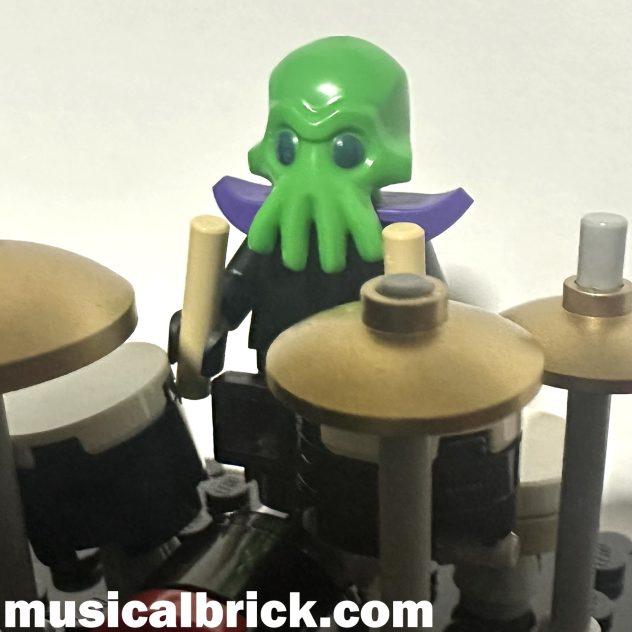
Nom is amphibious, tentacular, from the Sirius system, and plays drums while wearing a full head mask. Sam Draper is behind the kit. The physical coordination required to perform at that level with your vision and hearing compromised is the kind of thing that makes you immediately understand this band is not a novelty act.
The head came from a LEGO Space Research and Development set. An alien piece with four mouth tentacles. It is exactly right. Purple shoulder pads complete the figure, adding the bulk and presence that a drummer of Nom’s reputation deserves.
Sometimes the piece exists and you just have to find it. This was one of those times. The tentacles were waiting.
Sol: the One Who Stayed
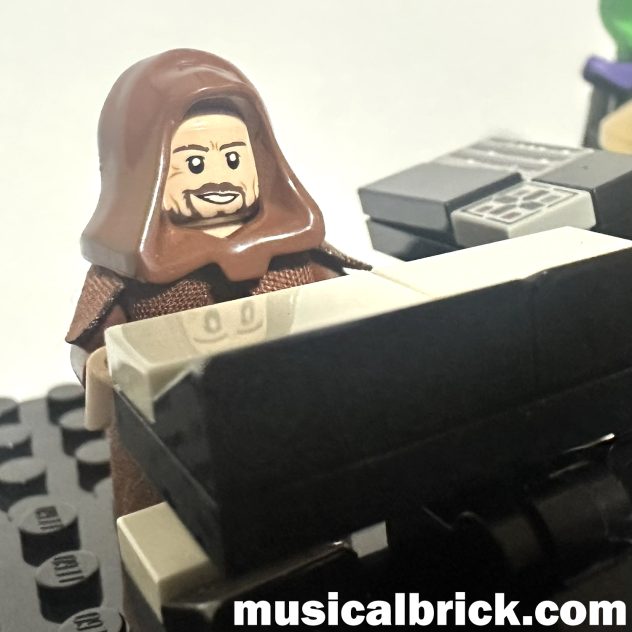
Sol is Henge’s only native Earthling. Roy Medhurst plays him. Where the others arrived from elsewhere, Sol began here and then kept going, entirely devoted to synthesizers.
The build solution is elegant: a cape and hood.
It sounds simple. It is not. The cape and hood combination in LEGO suggests mystery, transformation, something between what a being was and what it has become. The hood obscures what he was. The cape implies a history. The synthesizer rig in front of him does the rest of the work.
The Stage
Four figures in a row is a catalogue. A stage is a performance.
So I built the stage.
Nom’s kit sits centre-back, anchoring everything. Sol’s synthesizer rig is to the left, hood up, presence implied. Goo holds the front left, bass forward, red cape catching whatever light the scene offers. Zpor stands front centre. The acrylic orb sits in its cone, exactly where it should be, doing exactly what it does at every Henge show, pulling your eye first and not letting go.
The Honest Assessment
By that standard, Henge works. The characters are visually distinct. The stage gives them context. Each figure required a different kind of decision, and the stage required one more: knowing when to stop.
🔴 Hello HUMANS
When did you last make something where the hardest part was a problem no instruction manual could solve?


Leave a Reply