
In 1983, Genesis released an album simply called Genesis. Its cover came from a Polaroid: designer Bill Smith’s one-year-old son had left his shape-sorter pieces scattered on the floor after going to bed, Smith photographed the arrangement on a whim, and Genesis picked it, unprompted, from several treatments he showed them. Smith himself has never been entirely happy with the result, though it isn’t the shapes he objects to. It’s the lettering, which he’d have wanted simpler and smaller. His own summary is the best one: “it’s a great picture but it’s not a great design.”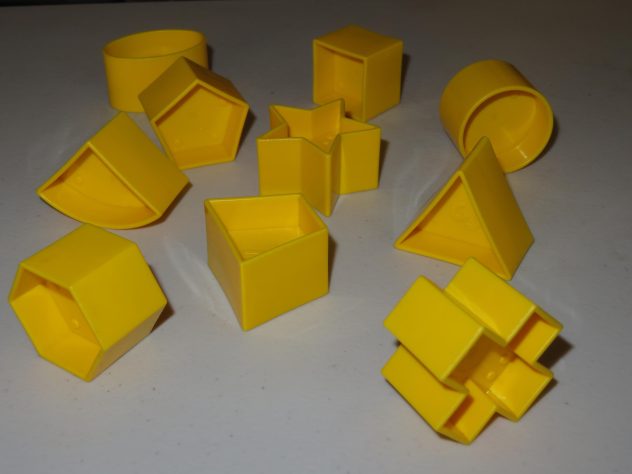
I wasn’t especially taken with the cover either, the first time I looked at it properly. Building it in LEGO changed that.
It was something of a reinvention. It was the first Genesis album written, recorded and mixed entirely at The Farm, the band’s new studio in Surrey. Rather than arriving with individually written songs, Tony Banks, Phil Collins and Mike Rutherford developed the material together through improvisation. Every track was credited simply to Genesis.
Even the cover felt like a reset. There was no elaborate fantasy artwork and no photograph of the band. Instead, the name sat plainly above a collection of brightly coloured children’s shapes scattered across a dark background.
Most fans simply know it as the Shapes album. Or the Mama album. I always called it Genesis Genesis.
Where the shapes came from
The cover was designed by Bill Smith, who had also worked on Duke and Abacab. The origin story is wonderfully mundane, but the image itself is a small act of transformation.
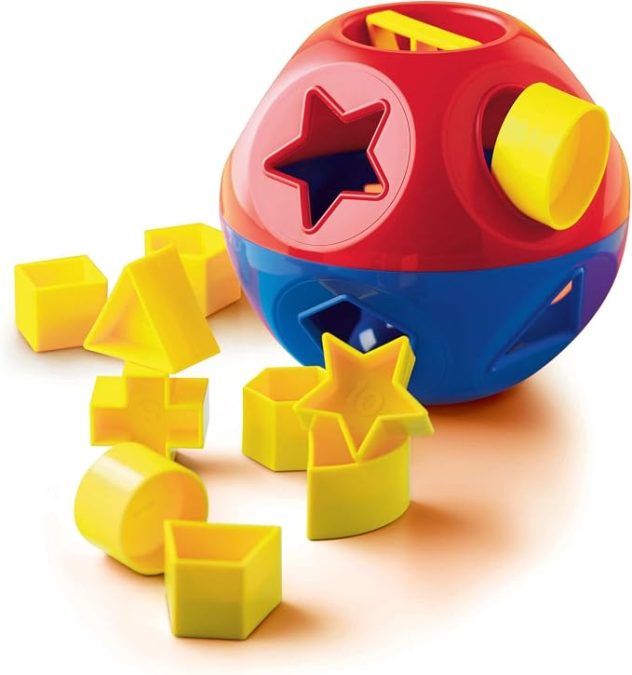
The shapes are pieces from a Tupperware Shape-O toy: a ball with openings that children push differently shaped pieces into, numbered to help them recognise shapes and how objects fit together. Left scattered on a carpet, they were ordinary toys. Photographed on Polaroid film, in low light with some blur, they became something else entirely. Smith has described the effect: no longer children’s pieces, but abstract floating shapes suspended in darkness. Nothing was staged. The blur and the dark background did that work by accident.
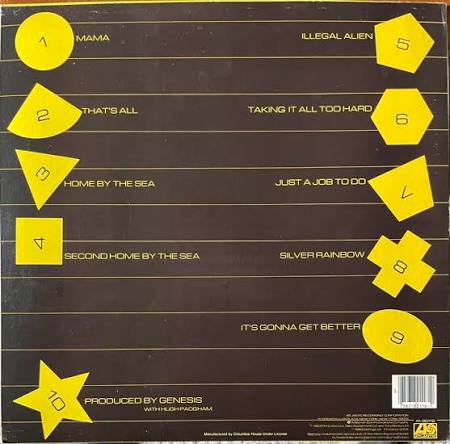
Smith carried some of that visual language into the packaging: the record contains nine tracks, numbered continuously from 1 to 9, and the numbered shapes are part of the sleeve’s visual system. So it isn’t quite the tempting piece of trivia that nine blocks equal nine songs. The connection is more interesting than that. The children’s toy became part of the album’s visual language.
An album built from pieces
There’s no evidence Smith intended the shapes as a metaphor for how Genesis made the album, but the parallel is hard to resist. The Shape-O is fundamentally about taking different pieces and discovering how they fit together, which was increasingly how the band worked. Rather than three musicians arriving with finished songs, Banks, Collins and Rutherford improvised at The Farm, recorded the sessions, listened back, and developed the interesting fragments into compositions.
Even the choice to call the album Genesis seems fitting. This wasn’t three songwriters presenting nine songs each. The credit simply said: Genesis. Three different shapes, one thing.
I doubt anyone at The Farm in 1983 was making that connection. Forty-three years later, it makes the cover more interesting.
Rebuilding the blocks
Which brings me to LEGO.
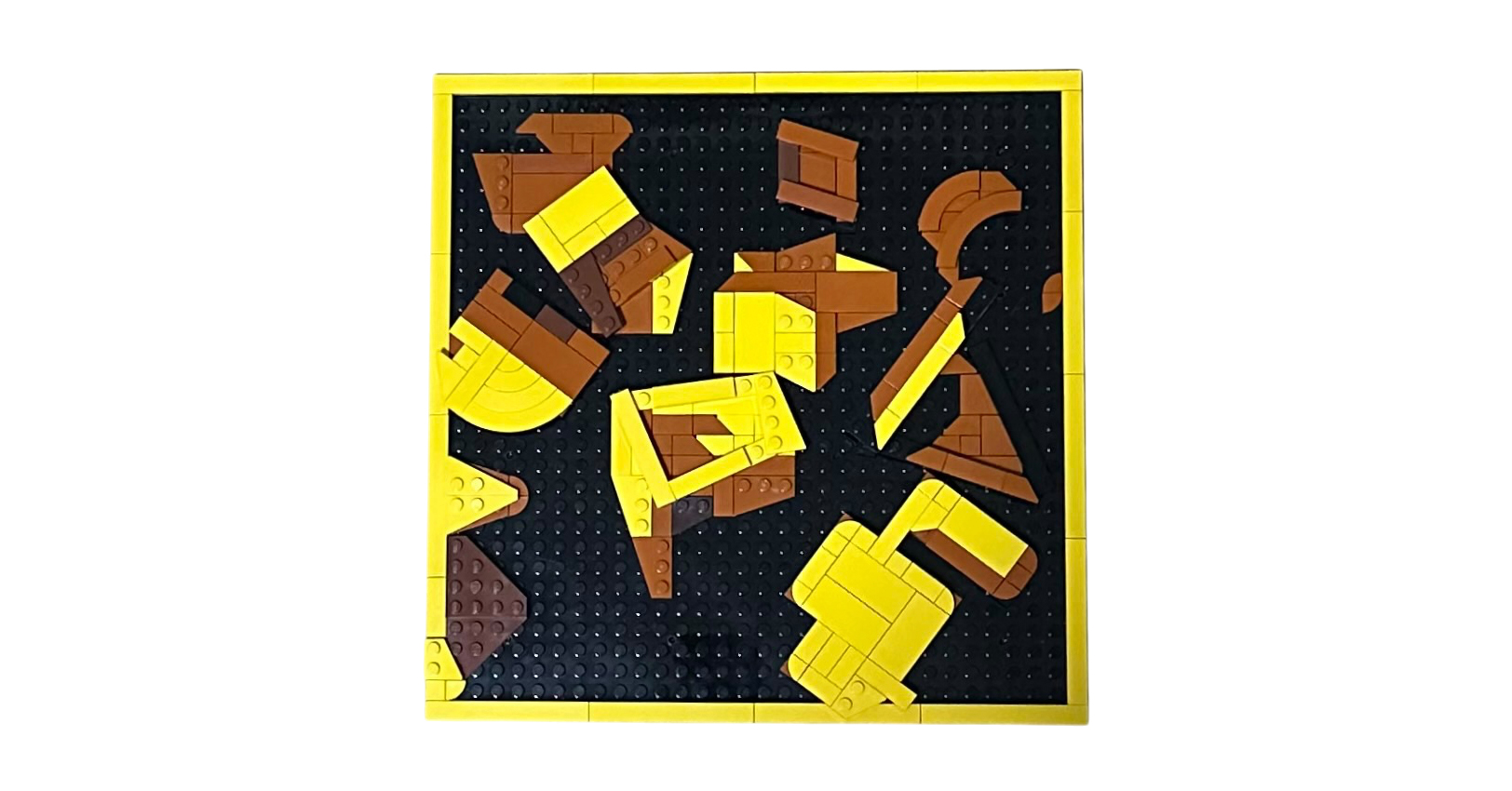
When I started recreating the Genesis cover for Musical Brick, there were two obvious approaches: a conventional mosaic, reducing the photo to a grid of 1×1 elements, or a literal three-dimensional build of the Shape-O blocks.
I’m doing neither. I’m trying to paint with LEGO shapes.
The model is essentially flat, but I’m using the geometry of different elements to create the illusion of the original three-dimensional blocks. Curved pieces become highlights. Wedges suggest edges. Slopes create changes of plane. Tiles establish areas of colour. Sometimes an element bears very little structural resemblance to the original toy piece, but viewed from above, its shape produces exactly the visual information the eye needs.
Up close, you see LEGO. Move back, and hopefully you see the blocks.
That distinction is increasingly central to how I think about Musical Brick. I’m not particularly interested in turning photographs into LEGO pixels; computers already do that extremely well. The interesting part is deciding what LEGO shape can make your eye believe it’s seeing something else.
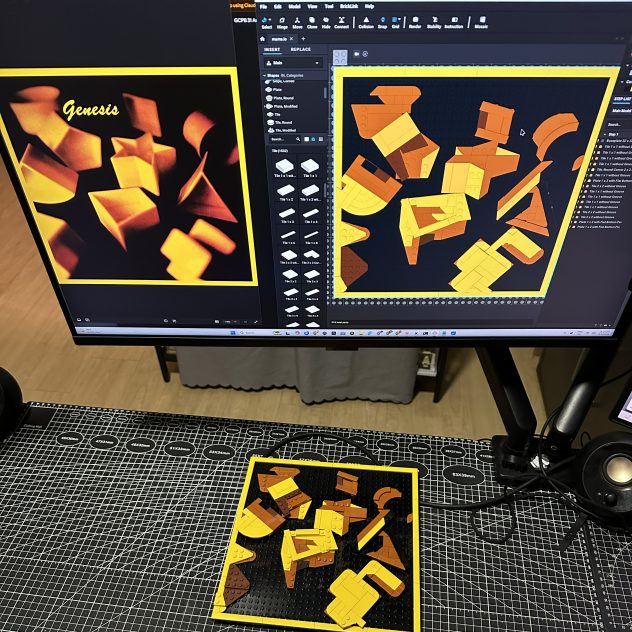
That makes Genesis an unusually appropriate album for this: the cover is already about elementary physical forms, translated once from a child’s toy into a photograph, then a sleeve, then a nickname for the record. Now I’m translating it again, into LEGO.
There’s a further layer to that translation worth naming. The original toy pieces only became “shapes” once darkness and Polaroid blur turned them into something abstract and floating. So a literal 3D LEGO rebuild of the Shape-O pieces would actually be less faithful to the cover than staying flat. What I’m painting isn’t the toy. It’s the illusion the camera made of the toy, which is closer to what Smith himself seems to have valued in the image even while he disliked the finished design around it. He’s described a good cover as a doorway into the album rather than a picture of the band, and that’s really what this project is trying to build a version of.
Bill Smith didn’t arrange the original pieces to encode some grand meaning. The idea emerged from seeing something already there, scattered on a carpet. My LEGO version develops the same way. I look through elements, rotate them, try combinations. A curved slope suddenly looks like part of an orange block. A wedge produces a shadow that shouldn’t work, but does. Gradually the image emerges from the available vocabulary of shapes.
In both cases, the shapes suggest what to do next.
Genesis
The word genesis means an origin, a beginning. The album represented a new phase for three musicians discovering what they could make collectively in their own studio. Its cover came from a toy designed for a child discovering how shapes fit together.
More than four decades later, I’m using another construction toy to find those same shapes again: different pieces, arranged until they become something that was never made of LEGO at all. Which, when you think about it, is what building has always been about.


Leave a Reply