
5 August 2000. Whitchurch Festival.
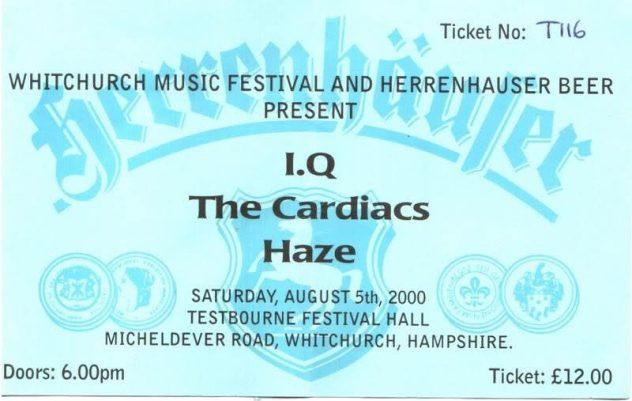
I was there to see IQ. That was the plan, the reason I bought the ticket. I’d been looking forward to it for weeks, excited for those long, winding arrangements, the melodic grandeur, that slow-burning prog satisfaction that only a band like IQ can deliver. I knew exactly what the evening was going to give me.
What I didn’t expect was Cardiacs.
There was no grand build-up, no anticipation, no recommendation from a trusted friend. They were simply another name on the bill before the main event. They walked onstage in long coats and schoolboy uniforms and launched into something that sounded like a brass band possessed by hyperactive sprites: military snare rolls snapping tight as rifle cracks, deranged harmonies arriving from odd angles, manic stop-start sections and melodies that felt simultaneously familiar and completely alien.
Within seconds, the music lurched, twisted, accelerated, fractured. Nursery-rhyme sweetness, chased by artillery rhythms and sudden harmonic pivots that had no right to work and yet somehow did.
It felt unstable. It felt dangerous. It felt completely euphoric.
I remember thinking: what on earth is this?
That was my introduction to Cardiacs. I have not been the same since.
Cardiacs are one of those rare bands that divide a room instantly. Some people hear chaos. Some hear ugliness. Some reach for the familiar dismissal: “weird for weird’s sake.” There is a long and distinguished tradition of hostile reviews, baffled audiences, and coins hurled at festival stages. In 1995, when Blur gave them a support slot at Mile End Stadium, the Britpop crowd rejected them so violently that the band apparently funded their post-gig dinner from the projectiles alone. Even on the Marillion tour years earlier, the response was so hostile that Fish had to walk onstage to intervene.
And then there are those who hear something else entirely.
Structure. Intention. Precision masquerading as pandemonium. Melody so dense and generous it borders on overwhelming. I fell hard into that second group at Whitchurch, and I have never found my way out.
Their songs sound like they’re about to derail. Tempos change without warning. Harmonies pivot sharply. Lyrics tumble over themselves in peculiar, almost incantatory patterns. It can feel like the musicians are daring each other to lose the thread entirely and yet they never do. The songs blossom into vast, luminous choruses. Hooks appear everywhere. Motifs return across albums with something close to mathematical intention. It is the sound of controlled collapse: something engineered to feel precarious while remaining completely, quietly intact.
That is what hooked me. Not the chaos on the surface. The absolute control underneath it.
You don’t casually listen to Cardiacs. They are not background music. They demand attention, engagement, patience. They ask you to commit. And when their internal language finally opens up to you, there’s a thrill to it that feels almost like recognition, as though you’ve discovered not just a band, but a whole new way music can be made to work.
You start to notice things: the hymnal quality of the shout-along sections, the sea-shanty undercurrents running beneath blistering punk intensity, the almost absurdly beautiful choruses hiding inside apparent madness. There are moments that feel ridiculous and moments that feel transcendent, often in the same breath, sometimes in the same bar.
Songs like Is This the Life?, which somehow found its way onto Radio 1 in 1988, briefly threatening something like mainstream recognition, and Dirty Boy, which builds and builds until it erupts into something almost symphonic, do not feel ironic. They are not smirking at the listener. They are sincere to the point of ecstasy. Earnest. Unashamed. Full-throated in their melodic ambition.
That sincerity is rare, especially in music that wears such a chaotic mask.
At the centre of it all was Tim Smith: composer, guitarist, creative architect, and guiding spirit through the band’s many incarnations. Tim didn’t write weird songs. He built closed ecosystems. Ecosystems where every motif eventually returned, every tempo shift was intentional, and chaos was not accidental but engineered. By all accounts he was generous, kind, and wholly committed to the work itself rather than to industry approval or the machinery of fame.
Tim suffered a devastating heart attack and stroke in 2008, and the band never performed live again. He passed away in 2020. The tributes that followed came not from the mainstream press, which had largely ignored or dismissed him, but from musicians who understood what they’d been watching, even when nobody else seemed to.
His passing felt like the loss of a singular creative voice. One of those rare figures who invent their own language and simply refuse, across decades, to compromise it.
The British music press largely didn’t know what to do with Cardiacs. They didn’t fit cleanly into punk, or prog, or indie, or pop. They were too melodic for noise, too chaotic for pop, too strange for mainstream consumption, too theatrical for the indie establishment. They were never algorithm-friendly. For years they were difficult to stream, hard to find on vinyl, poorly distributed, existing almost entirely through community, passed hand to hand like a particularly strange secret.
And yet: Blur. Radiohead. Faith No More. These are not minor names. Their admiration was genuine and freely stated. You don’t need chart positions to leave a mark. Legacy isn’t always measured in sales figures. Sometimes it’s measured in the creative minds you permanently reshape.
Cardiacs sound deeply, specifically English, but not in any clichéd sense. There is seaside melancholy in their melodies. There are echoes of hymn books and brass bands. There is a peculiar strand of British eccentricity running through them, a blend of whimsy and menace rooted somewhere between the village fête and the angular avant-garde. Listening to them can feel like stepping into a parallel version of England, one where nursery rhymes collide with chromatic composition and everyone sings along at full volume regardless of consequence.
And then, in 2025, something extraordinary happened.
After more than eighteen years without new material, LSD arrived: an album that had been in gestation since the mid-2000s, completed posthumously by Jim Smith, Kavus Torabi, and the extended Cardiacs family from recordings and ideas Tim had developed before his illness. Released in September 2025, it was greeted not as a curio or a tribute act, but as a vivid, vital piece of work in its own right.
LSD is not a nostalgia exercise. It is a continuation of a musical language that was always entirely its own. The off-kilter harmonies are there. The intricate instrumental interplay is there. The manic undertow, the melodic generosity, the moments that shift from unsettling to euphoric without warning, all of it intact, all of it alive. The long first single Woodeneye, released ahead of the album, crackled with energy and served notice that whatever Cardiacs are, they are not finished.
In some corners of the prog world, LSD already sits among the most admired releases of the year. Not because it fits a category, but because it refuses to. It arrives as proof that the internal logic Tim Smith spent decades constructing was robust enough to outlast him.
Some music is meant to be marketed, positioned, and pushed through recommendation algorithms. Some music is built for the playlist, the passive listen, the mood-regulation moment.
And then there is music that sits outside all of that. Music that waits. Music that exists just beyond easy categorisation, just outside the mainstream current, discovered by accident more often than by design.
Cardiacs are that second kind of music.
I didn’t go to Whitchurch Festival in August 2000 to find them. I was there for IQ, ready for something I already understood. And then something I didn’t understand at all stepped onto that stage and detonated quietly inside my head, and here I am, twenty-five years later, still not fully recovered.
If you’re in the mood for something that sounds like a marching band possessed by angels, or a prog band raised on nursery rhymes and English melancholy, or pure melodic intensity wrapped in glorious, controlled madness, look them up.
Start anywhere. You’ll know within thirty seconds whether your brain clicks with it.
If it does, welcome.
If it doesn’t, that’s absolutely fine.
But if it does, you may never quite recover.


Leave a Reply