
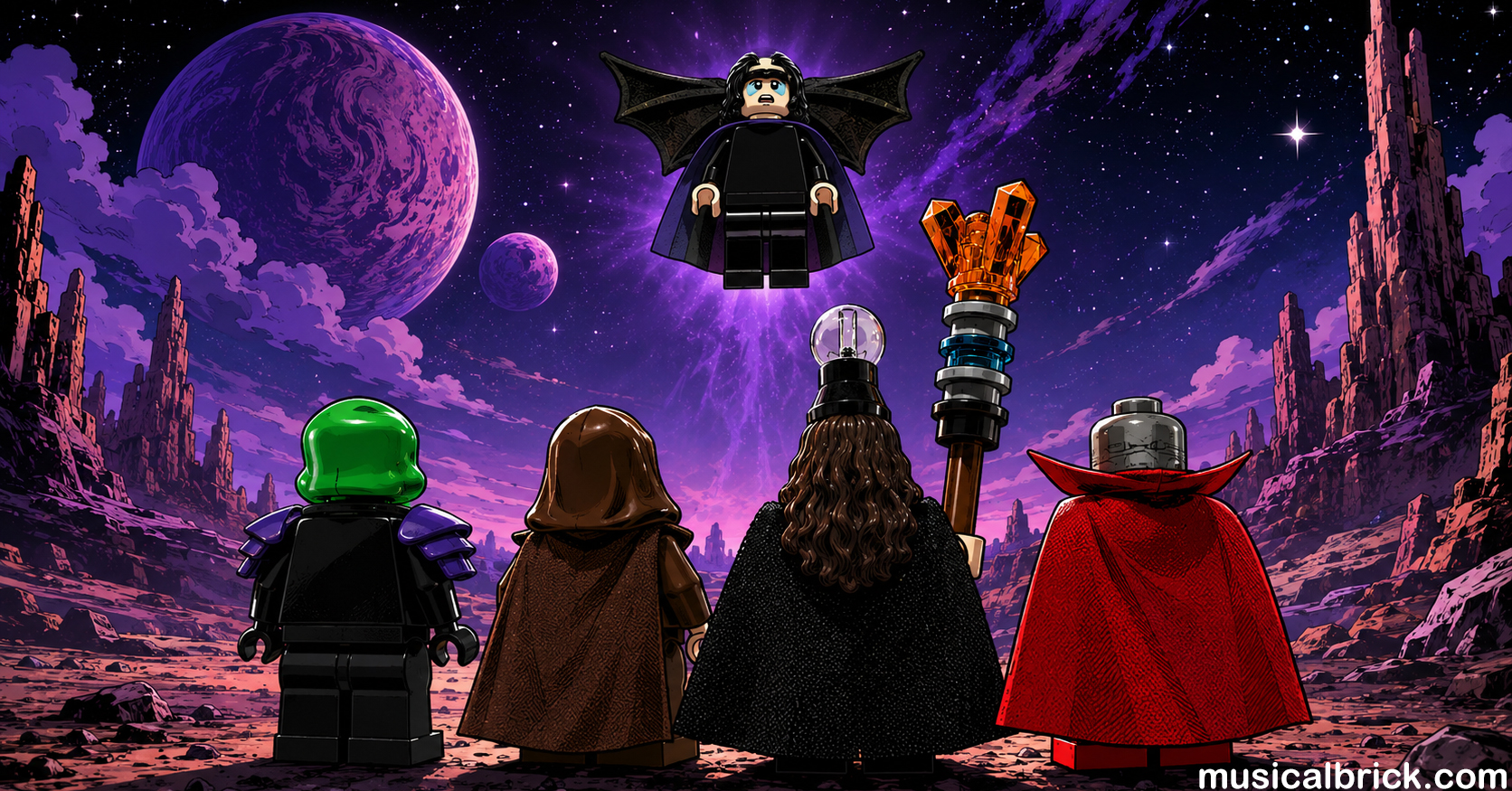
The internet will not give you a Genesis and HENGE connection. Search for HENGE and the names that come up make sense: Gong, Ozric Tentacles, Cardiacs, rave culture, space rock, psychedelia, and festival culture, which is their natural habitat. I have covered this wider territory before in Prog Rock Didn’t Die. It Went Electronic, and HENGE fit beautifully into that continuation, though Genesis do not fit there directly.
If HENGE have older relatives, they are easier to locate near Gong than Genesis, since that connection is public, obvious, and musically sensible; Gong and HENGE make sense on the same poster, cosmic, playful, psychedelic, and unembarrassed by the idea that music can be a journey through space. Peter Gabriel-era Genesis come from a different corner of British musical weirdness, and yet when I look at HENGE I still feel a flicker of recognition, not because they sound like Genesis, but because both bands understand something that has always mattered to Musical Brick: that a performance can be more than songs, that it can be theatre, myth, ridiculous, serious, and a world all at once.
Peter Gabriel-era Genesis were never just five musicians on a stage. At their strangest and best, they created a place for the audience to enter, and Gabriel became a series of characters: a fox-headed figure in a red dress, Britannia, an old man, Rael, a flower, the bat-winged Watcher of the Skies. Those costumes were not decoration, they changed the meaning of the songs, so the audience did not simply hear the music, they entered the story. And on the surface, it was serious: Gabriel’s characters were uncanny rather than comic, and the Watcher of the Skies was built to unsettle rather than amuse.
HENGE do something similar, through a different machine, but they flip the mood. Where Genesis played it straight-faced, HENGE play it for laughs, arriving as visitors, interplanetary messengers, cosmic beings bringing warnings, joy, absurdity, and extremely danceable music. The costumes are not extra, they are part of the transmission. With a lesser band, this would collapse fast, but HENGE can really play, and that is the secret: the joke works because the musicianship is serious, the visuals work because the grooves are real, and both bands ask the audience to accept something potentially absurd, then reward that trust with music strong enough to make the absurdity feel necessary.
The Difference Between a Lineage and a Shelf
Influence is a straight line, but imagination is messier. A record collector would file Genesis under progressive rock and HENGE near psychedelic space rock, and a music historian would be right to avoid forcing a direct connection where none exists. But Musical Brick does not think in family trees, it thinks in shelves, and on one shelf sit artists who use music to build worlds. On that shelf, Peter Gabriel’s Watcher of the Skies stands quite comfortably near the aliens of HENGE; they do not have to be related, they just have to understand each other.
The connection is theatrical, not genealogical. Both bands know a concert can be a temporary universe, both mix humour with sincerity, both let costumes reveal rather than hide, both reward an audience for playing along, and both, in very different ways, look at humanity from a distance. Watcher of the Skies imagines a cosmic observer looking down on Earth after humanity has vanished, vast, lonely, and unsettling, while HENGE feel like a different kind of alien arrival, turning up before the disaster, plugging in the synths, and telling us to stop destroying everything before it is too late. Genesis gave us the alien witness and HENGE give us the alien intervention; both are looking at Earth and asking what on earth we are doing.
Musical Brick is drawn to musicians with a visual identity strong enough to become an object. Some bands sound good but never become brick figures in the mind, while others arrive almost fully formed. Peter Gabriel-era Genesis are perfect for this, with the flower mask, the fox dress, Britannia, Rael, and the Watcher all functioning as icons rather than mere costumes. HENGE are the same, with the plasma-ball wizard hat, the alien faces, the robes, the strange seriousness, and the joyful nonsense making every show feel like both a gig and a visit from another civilisation, not because they are miniature, but because they are mythic, and mythic things want to be built.
No Connection Required
So no, I am not claiming a hidden lineage, or that HENGE secretly came from Peter Gabriel’s dressing-up box. They come from their own universe, but sometimes two universes overlap in the imagination of a listener, and a band from the 1970s and a band from the 2010s can produce the same feeling: that music has become theatre, that theatre has become ritual, and that everyone in the room has agreed to believe in something wonderfully strange for a while. And in the case of HENGE, absolutely fun! That is enough.
There may be no connection between Genesis and HENGE, but somewhere on Musical Brick’s shelves, the Watcher of the Skies is looking across at the aliens of HENGE, and they seem to understand each other just fine.
N.B. HENGE have played WOMAD (twice), which Peter Gabriel co-founded, putting them, briefly, in his orbit. It proves nothing about lineage, but it is too good a footnote to leave out.
UOMAD not WOMAD
Need to change the festival to Universe of Music and Dance now UOMAD
Comment credit by gore_tech


Leave a Reply